Exploring Democratic Inventiveness
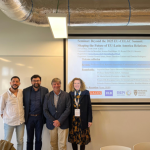
The UACES Annual 56th Conference, which this year took place in Prague, addressed the theme of reimagining Europe, covering a wide range of subjects from security, border and migration studies to digitalisation, the green agenda and Space policy. Notable attention was dedicated to critical and epistemologically challenging perspectives about meta-narratives of European studies, core-periphery relations and actorness of Central and Eastern European countries. I had an excellent opportunity to contribute to this necessary conversation by participating in two panels, co-convened by Eli Gateva (University of Oxford) and Julia Rone (Vrije Universiteit Amsterdam), that explored the lessons of defending and strengthening democracy through democratic innovations. Organised as a part of developing a special issue on this highly relevant topic, the symposium uncovered fascinating and still under-theorised insights about political mobilisations in countries that are regularly associated with democratic decline or stagnation.
In my research, I have been interested in rethinking democratisation as an ongoing process of political subjectification that concerns the ways in which democratic principles, such as equality, freedom and resistance to oppression, are reimagined and sought to be realised in national contexts. In one such instance, I examine the origins of the Latvian digital platform “MyVoice” in the aftermath of post-recession protests in the country that was among the hardest-hit places in the 2009 economic crisis. The platform was created by a small grassroots group in 2011 that used an existing legal provision that allowed for citizen-submitted legislative initiatives. If the required 10,000 signatures were not so easy to collect on paper, on the internet it proved to be a much easier – and highly popular – exercise of direct citizens’ voice. The platform, operated by a non-governmental organisation and supported by microdonations of its users, has since become a major site of political participation with a significant impact: since the platform’s inception, 118 laws in Latvia have been changed because of citizens’ initiatives.
“MyVoice” illustrates that democratic initiative is not solely situated with formal political institutions or a pre-determined set of civil society and third sector organisations. It can be born anywhere and anyplace, prefiguring new capacities for existing institutions and practices. In this process, democratic innovations are situated to acquire a much larger role than being just a consultative mechanism – they can also act as a space of protest, resistance and, most importantly, as a site of constructing new collective identities. This interplay between protest and inventiveness was especially pertinent to the focus of our symposium at the UACES Conference. In late autumn of 2025, reacting against the Latvian parliament’s sudden withdrawal from the Istanbul Convention – an international human rights treaty that has become a battleground of anti-gender politics – “MyVoice” became one of the main channels of conveying a wider public rejection of the decision. The petition against the withdrawal from the Convention gathered a record number of signatures (almost 70,000) in a record amount of time (over three days). The platform offered a competing site of political representation to traditional institutions, rivalling the image of society presented by the parliamentary majority. As such, it underlined the potential of democratic innovations to become spaces of resilience, which is particularly relevant in democracies under strain.
The thread of unexpected patterns of citizen self-organisation ran through other presentations at our panels. Postsocialist Europe has largely been studied through the lens of democratic backsliding, with the focus on countering democratic decline remaining on external actors such as the European Union. However, mass protests and grassroots campaigns in countries like Bulgaria, Hungary and Serbia have demonstrated that this lens on democratic defence is limited. The overall conclusion of the symposium was that it is high time to explore democratic inventiveness as a conceptual perspective to better understand response to autocratisation and backsliding. Tracing these new practices, tools and meanings of resistance and democratic reimagining shows that democratic decline does not have to be a foregone conclusion in the region itself and also beyond it.